 Park / Garden
info About this place
Baomo Garden is located in Zini Village, Panyu District, Guangzhou. It is more than just a garden: covering an area of about 100000 square meters (about 25 acres), it is a complex of comprehensive culture, traditional South China architecture, and South China garden art.
Baomo Garden was built in the late Qing dynasty (1644 – 1911 AD) as an extension of the Lord Bao Temple located east of the garden. The temple itself was built in the reign of the Jiaqing Emperor of the Qing dynasty to honor Lord Bao Zheng of the Song dynasty (960 – 1279 AD) and his qualities of incorruptibility and justice. The original garden was destroyed in the fifties. Reconstruction began in 1955 and lasted eight years. The rebuilt garden is large and elegant, and a good example of South China gardens.
Artworks inside the garden:
Baomo Garden can be divided into many areas and scenic spots. At its front gate stands a grand and magnificent white stone archway. Inside the garden, pottery sculptures, ceramic sculptures, brick carvings, stone carvings, and wood carvings can be seen everywhere. The most impressive piece is the reversed ceramic sculpture “Along the River During the Qingming Festival”, which has been added to the Guinness World Records. Another example of this type of work is the huge brick carving, the Wall of Flowers and Birds. A bronze statue of Confucius is displayed in the Treasure Pavilion on Lychee Island for visitors to worship.
In addition to the attractions and artworks mentioned above, there are many other famous scenic spots inside the garden:
Zhiben Hall
Zhiben Hall was originally the Lord Bao Hall. In its lobby hangs a Chinese painting of a lotus flower, symbolizing Lord Bao’s pure and holy spirit. Behind the hall is a granite tablet engraved with the words “Baomo Garden”, the only relic of the garden.
Baomo Hall
In the lobby of Baomo Hall hangs a portrait of Mr. Bao by the famous Chinese painter Han Yunlang. The two elm trees in front of the hall are nearly a hundred years old. Because they are tall and strong and stand directly in front of Mr. Bao’s portrait like two guards, they are called the “General Trees”. On the terrace bridge is a group of pottery sculptures telling the story of Mr. Bao throwing an inkstone into the river.
Longtu Hall
Longtu Hall was built in the traditional South China architectural style. It stands out for its fine, elegant brick carvings, wood carvings, clay sculptures, and more. On entering, visitors see a giant rosewood screen measuring 3.5 meters × 4.5 meters (about 11.5 feet × 14.8 feet). It took 16 artists about 18 months to complete this screen. In front of it stands a statue of Lord Bao that embodies his commitment to principle.
Zhao Tailai Collection Hall
The Zhao Tailai Memorial Hall was built in the style of a late Qing dynasty temple of the Pearl River Delta. Mr. Zhao is the permanent honorary director of Baomo Garden. The hall houses his donations to the garden, including a bronze Guanyin statue, a horse, a censer, and 41 large Tibetan statues.
Qianxiang Corridor
Qianxiang Corridor, about a thousand meters (3281 feet) long, winds along following the terrain and layout of the surrounding architecture. It not only offers shelter from rain and sun but is also a great place for sightseeing and relaxing.
Qingping Lake
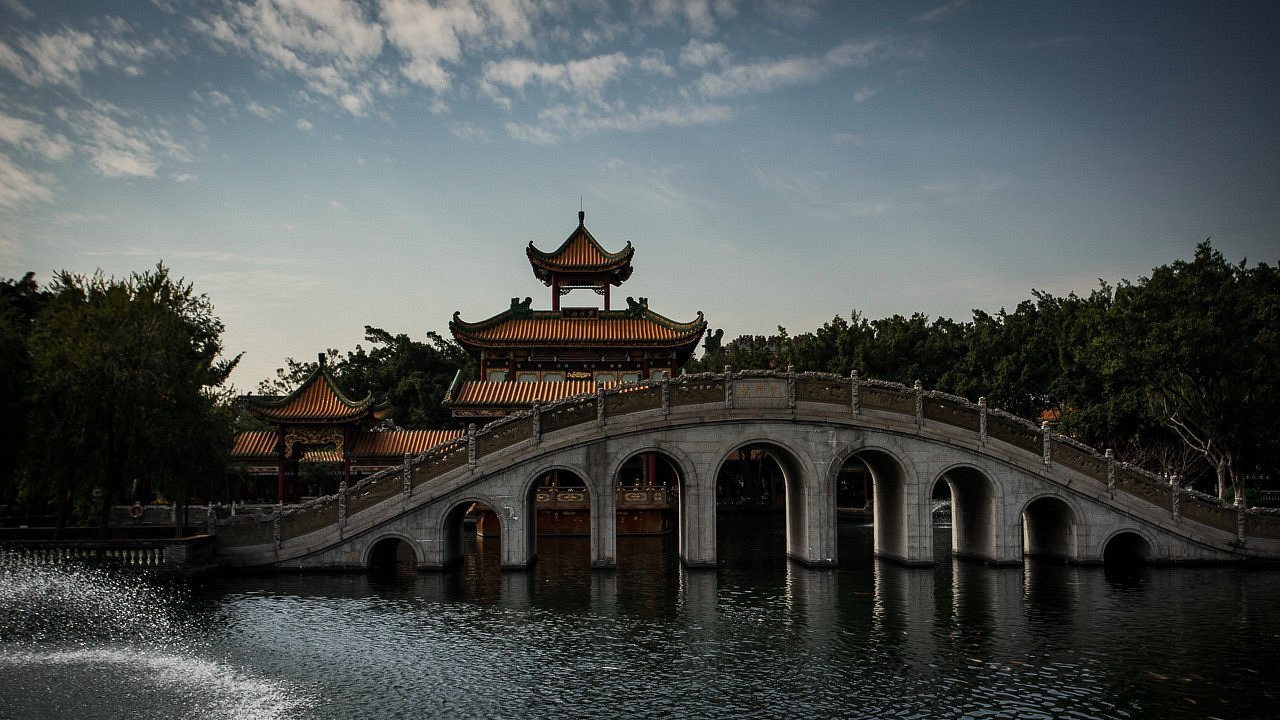
The garden features many wonderful water landscapes. Lychee Bay Scenery, Qingping Lake, Baomo Lake, and a 1000-meter-long river are connected to one another. They are glassy like mirrors and flow all the time. More than 30 bridges cross these waters for the convenience of visitors. The most famous is the Purple Ribbon Bridge over Qingping Lake. It is a traditional stone bridge with 9 arches, carved with famous Chinese stories such as “Romance of the Three Kingdoms ( 220-280 AD)” and “Romance of the Sui Dynasty (581-618 AD) and the Tang dynasties (618-907 AD)”. Another attractive water sight on Qingping Lake is the Zidong Boat. The two-story boat is 21 meters (69 feet) long, 6.8 meters (22 feet) wide, and 8.7 meters (29 feet) high; it is made of reinforced concrete and decorated with teak. The wood carvings and wooden furniture on board are exquisite. On the first floor, visitors can sip tea and enjoy Cantonese music and opera performances.
Plants and flowers
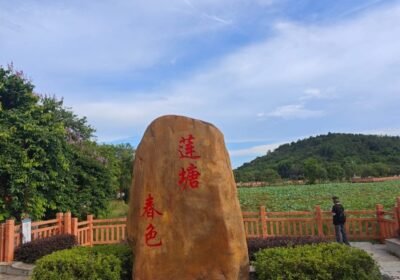
Among the most beautiful features of Baomo Garden are its plants and flowers, which add beauty to the garden all year round. Some of the best places to enjoy these plants: the Rose Garden, the Lotus Pond, the Orchid Garden, and the purple bamboo groves.
Address: Dong’an Road, Zini Village, Shawan Street, Panyu District, Guangzhou